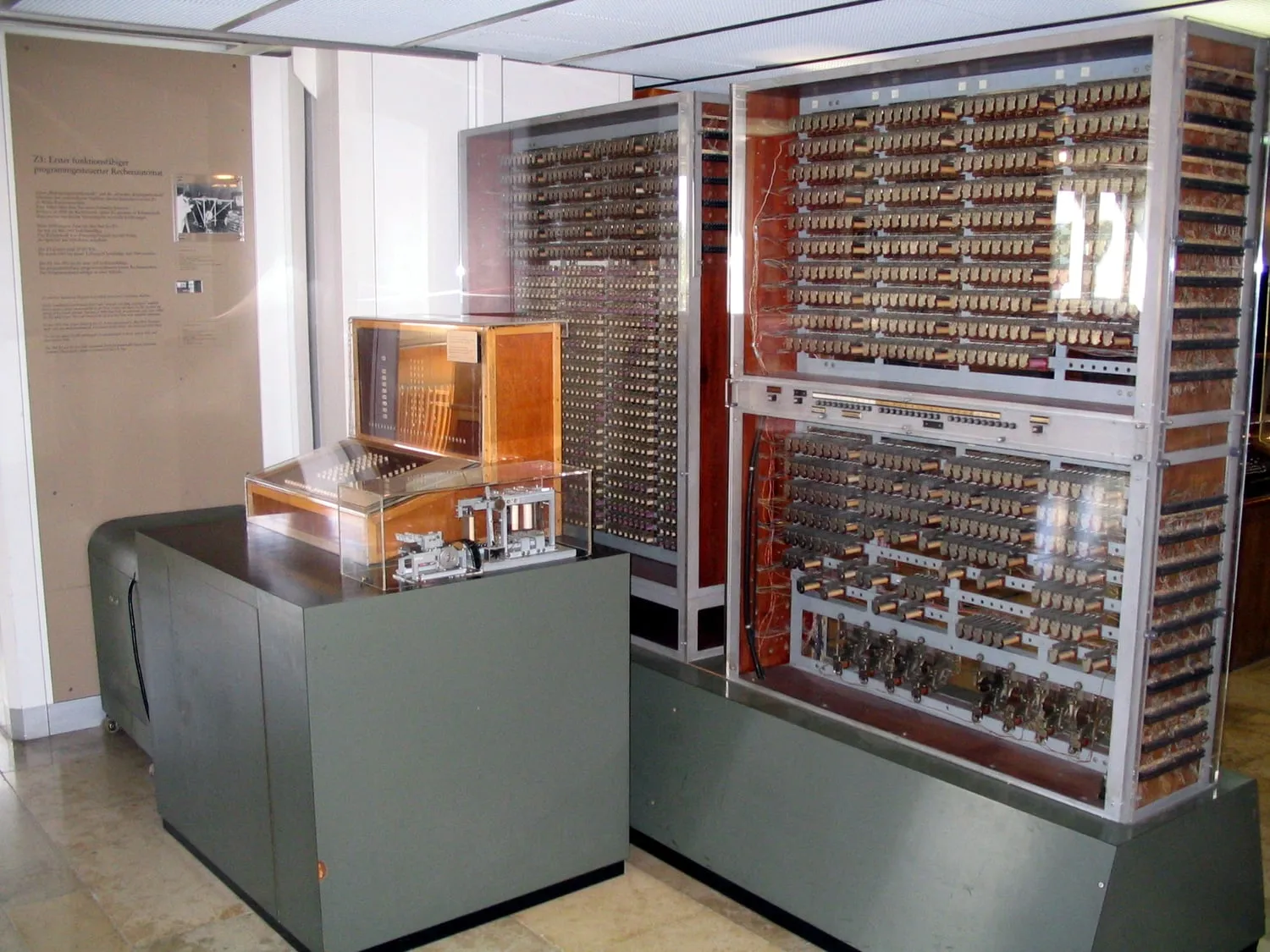
On 12 May 1941 the German engineer Konrad Zuse presented the Z3, a machine he had built in his Berlin workshop, to an audience of scientists. It is widely regarded as the first working program-controlled, fully automatic computing machine. The source cited here is the Z3 page of the Konrad Zuse Internet Archive, the digital archive of Zuse’s papers, drawings, and documents hosted by the Zuse Institute Berlin, the German research institute named after him.
The Z3 was electromechanical, built from about 2,000 telephone relays. It worked in binary and, unusually for its time, used binary floating-point numbers with a 22-bit word, which let it handle a wide range of magnitudes without manual scaling. It ran at a clock rate of only a few cycles per second, so it was slow by any modern measure, but its logic was sound. Crucially, the Z3 was program-controlled: its instructions were read from a punched film tape, so changing the calculation meant feeding in a different tape rather than rewiring the machine. Initial values were entered by hand on a keyboard, and results were shown on a display of lamps.
That separation of a stored sequence of instructions from the fixed machinery is what makes the Z3 a landmark. Earlier calculators could perform arithmetic, but they were wired for a single task; the Z3 could be told what to do by its program. The original machine was destroyed in an Allied air raid on Berlin in 1945. Zuse later supervised a working reconstruction, which is held and displayed by the Deutsches Museum in Munich.
A note on sourcing. The events of the Z3’s construction in wartime Berlin left few contemporaneous published records, and the original machine no longer exists. The strongest verifiable documentation comes from institutions that hold the surviving materials: the Konrad Zuse Internet Archive, which digitizes Zuse’s own manuscripts, technical drawings, and patent filings, and the Deutsches Museum, which holds the reconstruction. The archive page cited here is curatorial documentation by the body that preserves the primary papers rather than a single original document, which for a destroyed wartime machine is about the best primary footing available.