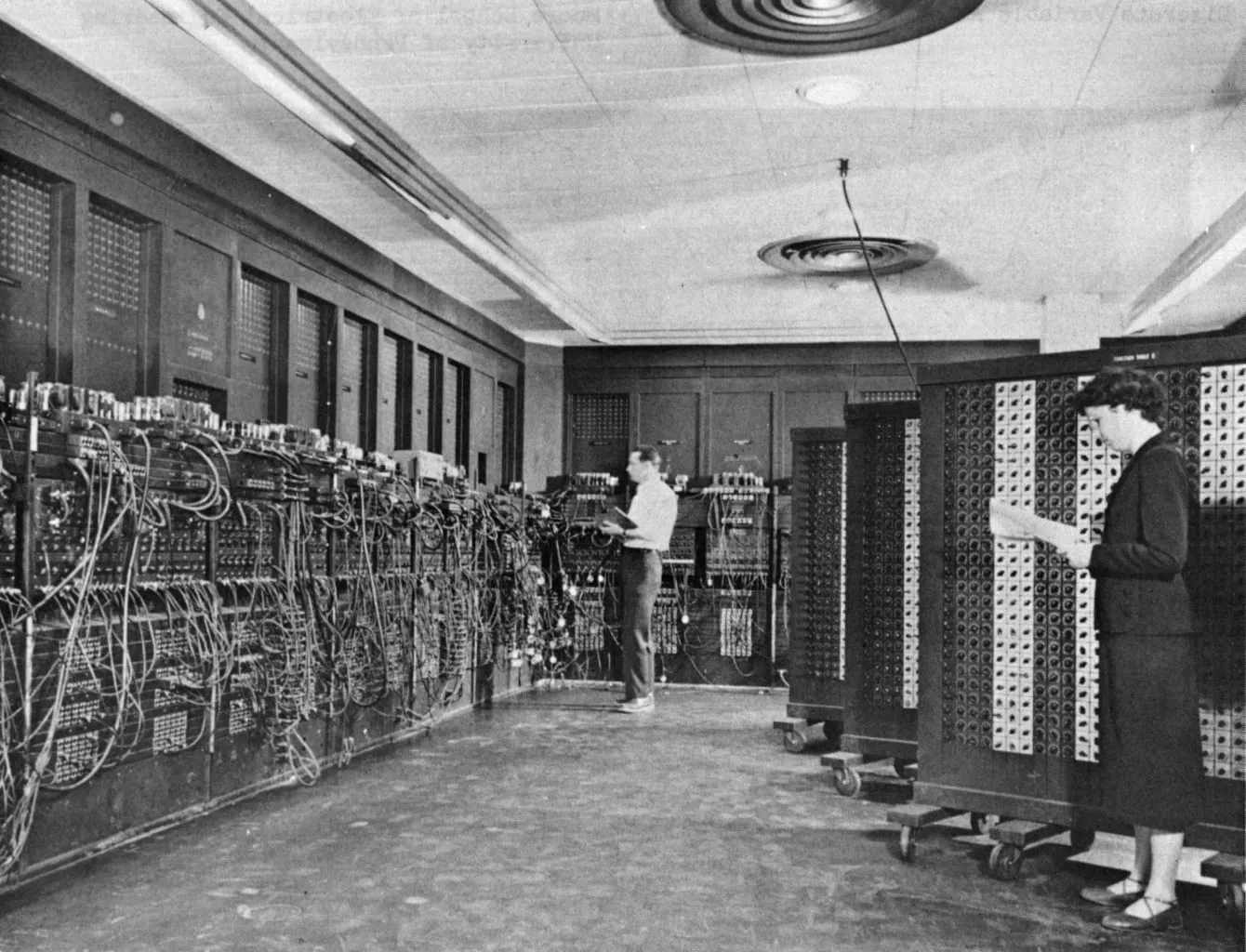
ENIAC, the Electronic Numerical Integrator and Computer, was built between 1943 and 1945 at the Moore School of Electrical Engineering at the University of Pennsylvania by John Presper Eckert and John Mauchly, under a wartime contract from the United States Army. It was publicly unveiled in February 1946 and is generally counted as the first general-purpose electronic digital computer. The primary source cited here is the ENIAC patent, “Electronic Numerical Integrator and Computer,” United States patent number 3,120,606, filed by Eckert and Mauchly in 1947 and granted in 1964, hosted on Google Patents.
What set ENIAC apart from earlier machines was that it was electronic. Instead of mechanical relays, which switch in thousandths of a second, it used roughly 18,000 vacuum tubes that switch far faster, and it could carry out thousands of additions per second, a speed perhaps a thousand times that of the relay-based calculators of the day. The machine was enormous, filling a large room, weighing about thirty tons, and consuming a great deal of power. It was originally designed to compute artillery firing tables, but it was general purpose in the sense that it could be set up to attack many different numerical problems.
The qualifier “general purpose” comes with an important limit for early ENIAC. It did not yet store its program in memory the way later computers do. Setting up a new problem meant physically reconfiguring the machine by setting switches and replugging cables, a process that could take a long time. The lesson drawn from that limitation, that the program should be held in the same memory as the data and changed as easily, became the stored-program idea that defined the next generation of computers and that traces back conceptually to Turing’s universal machine.
ENIAC’s patent later became famous for a second reason. In the 1973 case Honeywell v. Sperry Rand, a United States court ruled the ENIAC patent invalid and unenforceable, in part on the ground that key ideas derived from earlier work by John Atanasoff. The dispute is a reminder that the question of who built the first electronic computer is genuinely tangled, but ENIAC’s place as the first large, working, general-purpose electronic computer to be put into public service is secure.